
What Is a P60? A Complete UK Guide for Employees
13th Nov 2026
What Is a P60 and How Does It Work? A Complete UK Guide
If you are employed in the UK, you have probably heard of a P60. But what exactly is a P60, what information does it contain, and why is it important?
A P60 is an important tax document that summarises an employee's pay and the tax deducted during a particular tax year. It provides a useful record of annual earnings and PAYE (Pay As You Earn) Income Tax.
Whether you are an employee checking your annual earnings, applying for a mortgage or keeping your financial records organised, understanding your P60 can be helpful.
In this guide, we explain what a P60 is, what information it contains, when you should receive one and how it differs from a P45.
1. What Is a P60?
A P60 is an official end-of-tax-year certificate issued by an employer to an employee who is still employed by them at the end of the UK tax year.
It summarises the employee's total taxable pay and Income Tax deducted through PAYE during that employment for the tax year.
The UK tax year runs from 6 April to 5 April the following year.
For example, the 2025/26 tax year ran from 6 April 2025 to 5 April 2026.
Employers must provide a P60 to eligible employees by 31 May following the end of the tax year.
A P60 is useful because it provides an annual summary of employment income and tax deductions in one document.
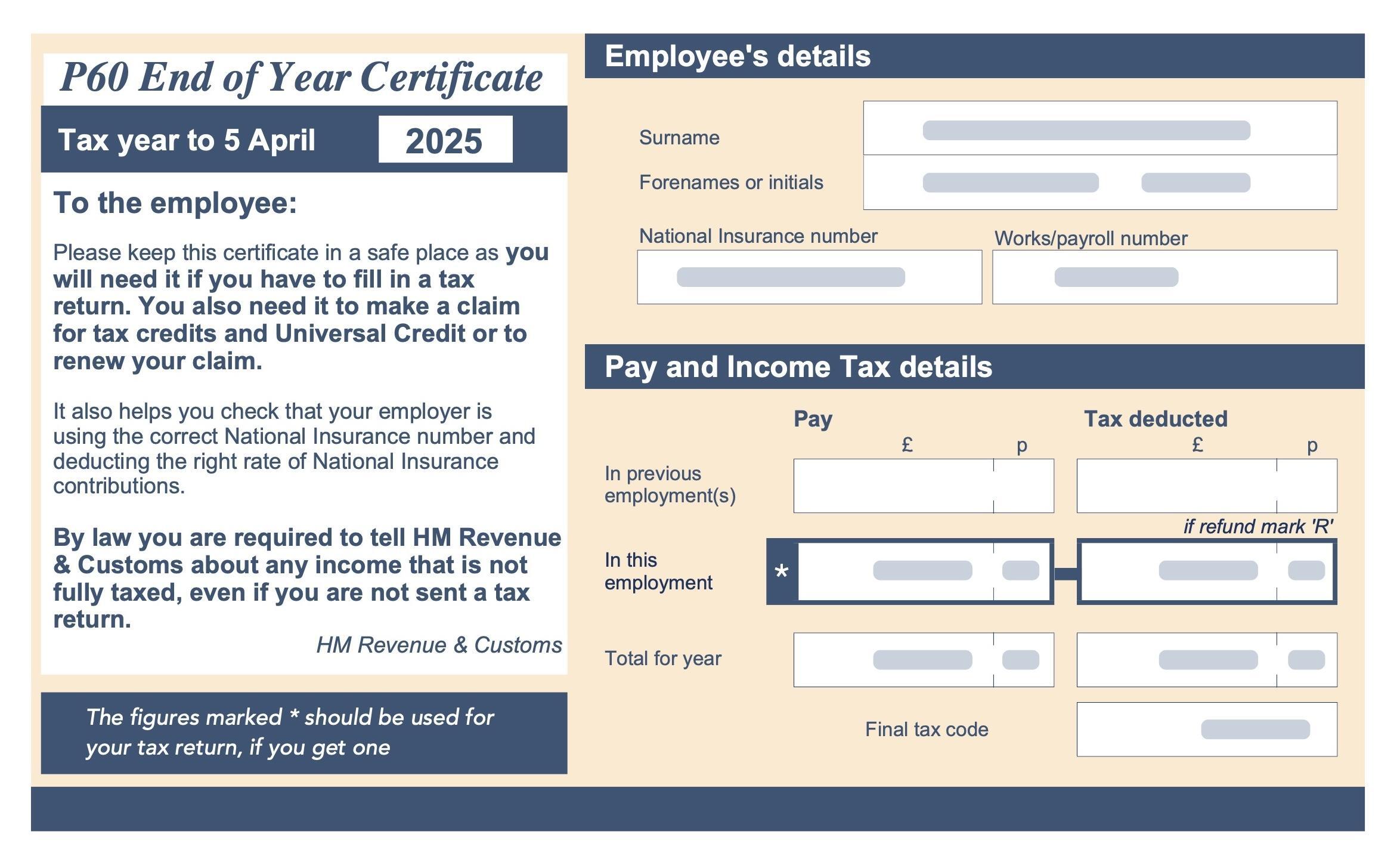
2. What Information Is Included on a P60?
A P60 contains important information about an employee's earnings and tax position.
The information typically includes:
Employee Details
The document identifies the employee and includes relevant personal information, such as their name and National Insurance number.
Employer Details
The employer's details identify the organisation responsible for issuing the P60.
Tax Year
The P60 specifies the tax year covered by the document.
For example, a P60 issued in May 2026 relates to the tax year ending 5 April 2026.
Total Taxable Pay
This shows the employee's relevant taxable earnings for the tax year.
It helps employees understand how much taxable employment income they received through that employment.
Total Income Tax Deducted
The P60 shows the total Income Tax deducted through PAYE during the relevant tax year.
This information can be useful when reviewing annual tax records or checking tax calculations.
National Insurance Information
A P60 also contains National Insurance information, including relevant National Insurance contributions and earnings information.
Tax Code
The document may include the employee's tax code information for the relevant employment.
Together, these details provide a useful annual summary of employment pay and tax.
3. When Do You Receive a P60?
Employers must provide a P60 to employees who are employed by them on 5 April, the final day of the UK tax year.
The deadline for issuing the document is 31 May following the end of the tax year.
For example:
- Tax year ends: 5 April 2026.
- P60 issue deadline: 31 May 2026.
- Document summary: Employment pay and tax for the 2025/26 tax year.
Employees who leave a job before 5 April would generally receive a P45 instead of a P60 from that employer.
P60s can be provided electronically or as printed documents.
4. What Is a P60 Used For?
A P60 can be useful for several financial and administrative purposes.
Proof of Income
A P60 can help demonstrate annual employment earnings when making certain financial applications.
For example, mortgage lenders, landlords or other organisations may request a P60 alongside additional supporting documents.
Acceptance depends on the organisation's requirements.
Checking Your Tax Information
A P60 allows employees to review the total employment income and Income Tax deducted during the tax year.
This can be useful when checking annual tax information or reviewing a potential tax refund.
Mortgage Applications
Some mortgage providers request P60 documents as part of their income verification process.
They may use the information alongside payslips, bank statements and other financial records.
Renting a Property
Some letting agents or landlords may request a P60 as supporting evidence of employment income.
Personal Financial Records
Keeping copies of P60 documents can help employees maintain an organised record of their employment earnings and tax information.
5. What Is the Difference Between a P45 and a P60?
Although both documents relate to employment and taxation, they serve different purposes.
A P45 is issued when an employee leaves a job. A P60 is issued at the end of the tax year to eligible employees who are still employed on 5 April.
Here is a comparison:
| Feature | P45 | P60 |
|---|---|---|
| Main purpose | Records pay and tax when leaving employment | Summarises annual pay and tax |
| When issued | When employment ends | After the tax year ends |
| Who receives it? | Employees leaving a job | Employees still employed on 5 April |
| Tax information | Pay and tax to date in that employment | Annual pay and tax summary |
| Issued by | Employer | Employer |
Both documents are important parts of the UK PAYE system.
6. Can You Get a P60 If You Have More Than One Job?
Yes. If you work for more than one employer and remain employed by multiple employers on 5 April, each employer will generally issue a separate P60 for that employment.
Each P60 will show the relevant employment pay and tax information for that employer.
For example:
- Employer A issues a P60 for your earnings from your first job.
- Employer B issues a separate P60 for your second job.
This helps you maintain a record of your employment income across different workplaces.
7. What Should You Do If You Have Lost Your P60?
If you have misplaced your P60, you should contact your employer or former payroll department.
They may be able to provide a copy or help you obtain the relevant information.
You can also access certain tax information through your HMRC Personal Tax Account.
HMRC may provide a replacement or alternative record of your tax information, depending on your circumstances.
It is sensible to keep copies of important tax documents in a secure location.
8. Can You Get a Digital P60?
Yes. Employers can provide P60s electronically, provided the relevant legal requirements are met.
A digital P60 offers a convenient way to access and retain annual tax information.
Benefits include:
- Convenient electronic access.
- Easy document storage.
- Reduced paper administration.
- Simple retrieval when needed.
- Convenient digital record-keeping.
Employers should ensure employees can access their electronic documents.
If an employee cannot access electronic payslips or tax documents, appropriate alternative arrangements may be needed.
9. Is a P60 the Same as a Payslip?
No. A P60 and a payslip are different documents.
A payslip provides details of an employee's earnings and deductions for an individual pay period, such as a week or month.
A P60 provides an annual summary of relevant employment pay and tax information for the tax year.
For example:
- A monthly payslip shows an employee's earnings and deductions for one month.
- A P60 summarises relevant earnings and tax deducted for the entire tax year.
Both documents can be useful when reviewing employment income and financial records.
10. Frequently Asked Questions About P60 Documents
What does P60 stand for?
P60 is the name of a UK PAYE tax document used to summarise an employee's pay and Income Tax for a tax year. It is commonly referred to as an end-of-year certificate.
When should my employer give me my P60?
Your employer must provide your P60 by 31 May following the end of the tax year, provided you are employed by them on 5 April.
Can I get a P60 online?
Yes. You may receive your P60 electronically through an employer's payroll system or another approved electronic delivery method.
You can also access relevant tax information through your HMRC Personal Tax Account.
Do I need a P60 if I am self-employed?
If you are genuinely self-employed and do not have employment income through PAYE, you would not normally receive a P60 for that self-employment.
However, you may receive a P60 if you also have employment income from a separate job.
Can I use a P60 as proof of income?
Yes. A P60 can be used as supporting evidence of annual employment income, although the organisation requesting it may also require payslips, bank statements or other documents.
What happens if my employer does not give me a P60?
If you are entitled to a P60 and have not received one by 31 May, contact your employer or payroll department first.
If the issue remains unresolved, you can seek guidance from HMRC or ACAS, depending on the circumstances.
Does a P60 show my monthly salary?
No. A P60 summarises annual employment pay and tax information rather than providing a breakdown of each monthly payment.
Your individual payslips provide details of your earnings and deductions for each pay period.
Can I have more than one P60?
Yes. If you work for multiple employers and remain employed by each on 5 April, you will generally receive a separate P60 from each employer.
Conclusion
A P60 is an important UK tax document that provides an annual summary of employment earnings and Income Tax deducted through PAYE.
It helps employees review their annual tax information, maintain financial records and provide supporting evidence of income when required.
Understanding the difference between a P60, P45 and payslip can also make it easier to manage your employment and tax documents.
For more information about payslips and payroll-related documents, explore the available resources and product options at ePayslips Online.
Visit ePayslips Online to explore our digital and printed payslip document options.
This article is intended for general educational purposes and does not constitute tax, legal or payroll advice. A P60 is an official employer-issued tax certificate. Any template or document-formatting service should not be represented as an HMRC-issued or verified P60.